No blank schematic
Describe what the board should do. siliXon asks a few questions, then picks the parts and draws the circuit.

 Try siliXon
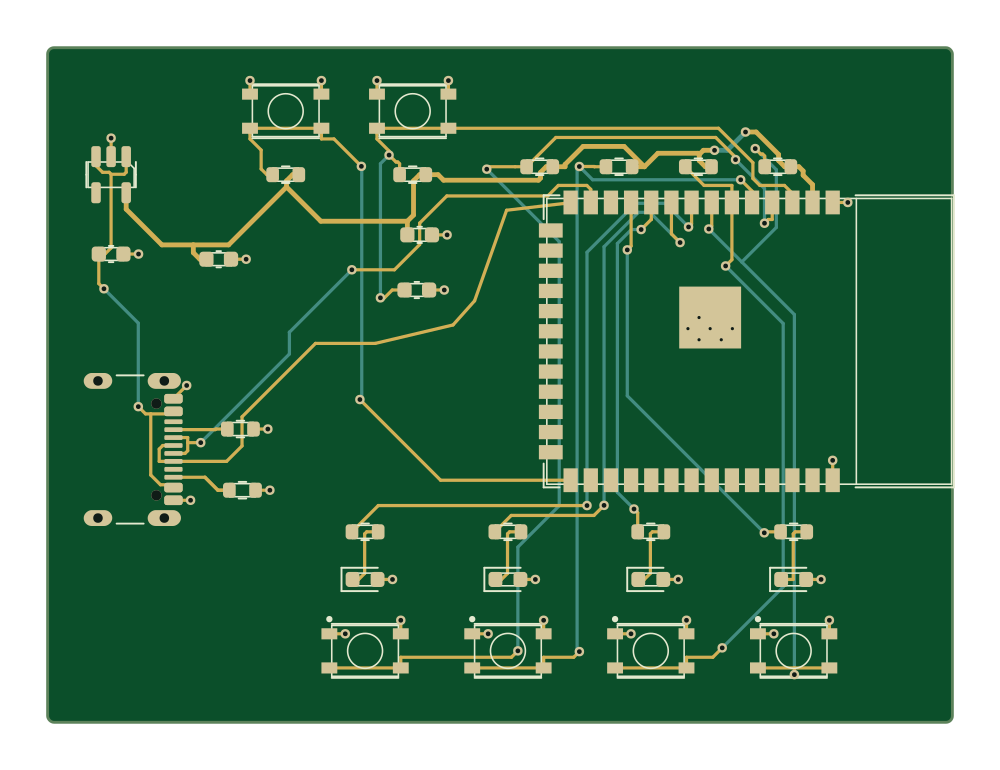
KiCad is a brilliant, free toolbox, and it has earned its fans. It also expects you to bring your own schematic, pick every footprint, place every part and route every trace, ideally over a few spare weekends. That is a great way to learn EDA, and a slow way to get a board. siliXon skips the apprenticeship: describe what the board should do in plain English, answer a few questions, and get a placed, routed board of up to four layers with real parts, Gerbers, drill files, a BOM and pick-and-place data.
Free plan. Runs in your browser.
Who leads on what matters when you want a board.


siliXon: A plain-English description
KiCad: A blank schematic
siliXon leads.siliXon: None
KiCad: EE knowledge and KiCad
siliXon leads.siliXon: siliXon; you steer and edit
KiCad: You, by hand
siliXon leads.siliXon: An editable PCB and fab files
KiCad: A PCB and a full fab package
Even.siliXon: Minutes
KiCad: Days to weeks
siliXon leads.siliXon: Up to 4 layers
KiCad: Up to 32 layers
KiCad leads.siliXon: None
KiCad: Place and route it all yourself
siliXon leads.Verdict
Choose siliXon to get a board in minutes, with no EDA skills.
Choose KiCad for full manual control and complex multi-layer boards.
siliXon todaysiliXon is in early beta and builds two- and four-layer, mostly digital boards. Review every design before fabrication.
Where KiCad is strongerFull manual control, up to 32 copper layers, analogue-heavy designs and a mature ecosystem.
Time to a prototype
From an idea to a board you can send to a fab, on one scale from zero. Estimates for someone new to each tool.
Describe what the board should do. siliXon asks a few questions, then picks the parts and draws the circuit.
The layout arrives placed and routed, and every part, trace and via stays editable.
Import an existing KiCad design and keep iterating on it in conversation.
| Feature | |  |
|---|---|---|
| Starting point | A plain-English description | A schematic you draw |
| AI generation | Generates the whole board | None built in |
| PCB layout | Editable in 2D and 3D | Full manual control |
| Copper layers | Up to 4 | Up to 32 |
| Part selection | Real, available parts picked for you | Open libraries, you choose |
| Design checks | Connectivity and manufacturing checks | ERC and DRC |
| Fab outputs | Gerbers, drill, BOM and pick-and-place | Gerbers, drill files, BOM and more |
| Firmware | Programmable over USB, with flashing steps | No |
| Layout prep | None; answer a few questions | You place and route every part and trace |
| Runs in | Browser | Windows, macOS and Linux |
siliXon is in early beta and builds two- and four-layer, mostly digital boards. Review every design before fabrication.
So far creating my first project for 10 min - onboarding seems quite smooth
I like the self validation and how it explains everything too, makes it easier for me to quickly cross reference and learn on the go
Response is very meaningful, I like how it asks you questions to verify and gives you the options to choose the answers with the recommended on the one it thinks is a better option
Good so far. It is helpful and gives me advice
I have to say I love the UI and UX, the front end is really fun to interact with, with the little dynamic touches etc
Super helpful and easy to use
Really good actually better than Flux ai
 siliXon vs Altium DesignerProfessional EDA for complex, multi-layer production boards
 siliXon vs SchematikAI that turns a prompt into Arduino, ESP32 and Pico projects
 siliXon vs Blueprint.ioAI build plans with parts, wiring and assembly steps
 siliXon vs Flux.aiBrowser ECAD with an AI agent that designs alongside you
 siliXon vs DiodeAI-assisted board design service, from spec to production
 siliXon vs QuilterAI placement and routing from your finished schematic
 siliXon vs SnapMagicAI copilot for Altium, built on the SnapEDA parts library
 siliXon vs CELUSAI that turns requirements into schematics and a BOM
 siliXon vs atopileCode-native electronics design, with an agent in the browser
 siliXon vs tscircuitOpen-source framework for designing PCBs in TypeScript
Not for every board. KiCad suits multi-layer, analogue-heavy and custom-library work. siliXon is faster for two- and four-layer, mostly digital boards.
Yes. Bring an existing KiCad design into siliXon and keep iterating on it.
siliXon. You start from a description instead of learning schematic capture, footprints, placement and routing first.
Yes. Both export Gerbers, drill files, a BOM and pick-and-place data; KiCad gives you finer control over them.