No code to learn
Describe the board in plain English. There is no design language to learn or review.

 Try siliXon
atopile lets you design electronics as code, with an agent in its browser IDE to help write it, which is perfect if what you were missing was another programming language. Once the code compiles, you still open KiCad and place and route the board yourself. siliXon takes plain English instead of code: describe what the board should do, and it picks the parts, draws the schematic, places and routes the layout and hands you the files to have it made.
Free plan. Runs in your browser.
Who leads on what matters when you want a board.


siliXon: A plain-English description
atopile: .ato code, or chat with its agent
siliXon leads.siliXon: None
atopile: Its code language and KiCad layout
siliXon leads.siliXon: siliXon; you steer and edit
atopile: You or its agent write code; you lay out
siliXon leads.siliXon: An editable PCB and fab files
atopile: A board you finish in KiCad, plus fab files
siliXon leads.siliXon: Minutes
atopile: Hours to days
siliXon leads.siliXon: Up to 4 layers
atopile: Set by your KiCad layout
Even.siliXon: None
atopile: Code the circuit, lay it out in KiCad
siliXon leads.Verdict
Choose siliXon to design a board without writing code or laying it out by hand.
Choose atopile to design electronics as version-controlled code.
siliXon todaysiliXon is in early beta and builds two- and four-layer, mostly digital boards. Review every design before fabrication.
Where atopile is strongerDesigns as reusable, version-controlled code with assertions and CI checks, an open-source compiler and the full KiCad editor.
Time to a prototype
From an idea to a board you can send to a fab, on one scale from zero. Estimates for someone new to each tool.
Describe the board in plain English. There is no design language to learn or review.
atopile leaves placement and routing to you in KiCad; its auto-routing is announced, not shipped.
siliXon asks what the board should do, not for modules, interfaces and assertions.
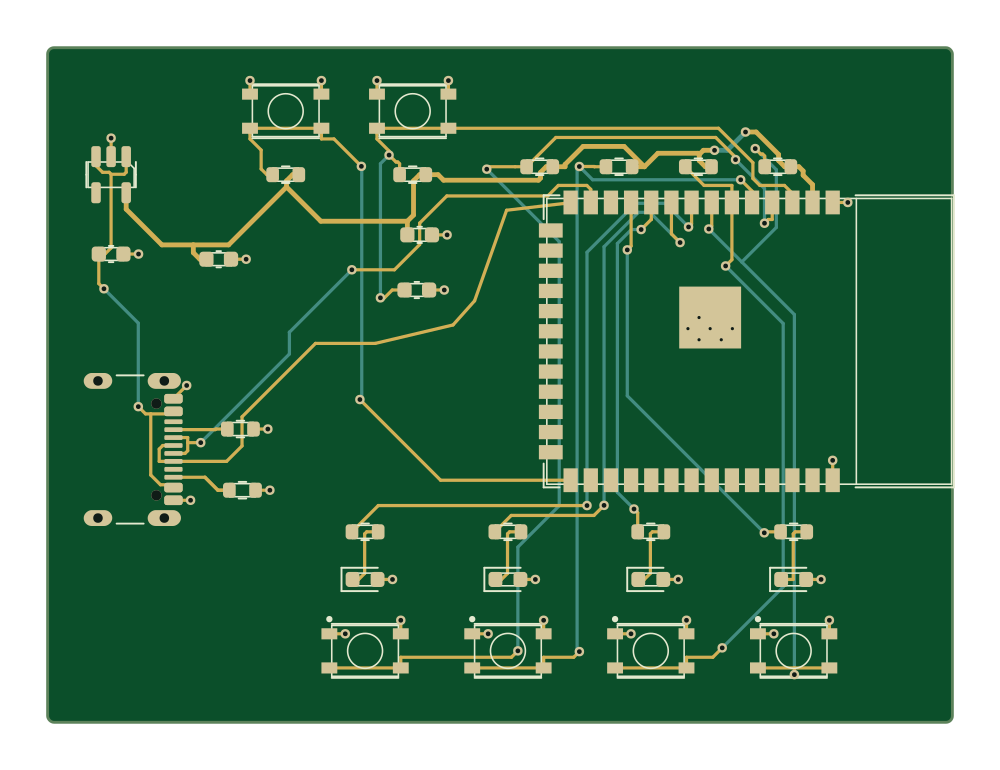
| Feature | |  |
|---|---|---|
| Starting point | A plain-English description | .ato code, or chat with its agent |
| AI generation | Generates the whole board | Agent writes code and picks parts |
| PCB layout | Editable in 2D and 3D | Manual in KiCad |
| Copper layers | Up to 4 | Not stated |
| Part selection | Real, available parts picked for you | Automatic picking of passives |
| Design checks | Connectivity and manufacturing checks | Compiler assertions and KiCad DRC |
| Fab outputs | Gerbers, drill, BOM and pick-and-place | Gerbers, drill, BOM and pick-and-place |
| Firmware | Programmable over USB, with flashing steps | Not stated |
| Layout prep | None; answer a few questions | Write the design as code, then lay it out in KiCad |
| Runs in | Browser | Browser |
siliXon is in early beta and builds two- and four-layer, mostly digital boards. Review every design before fabrication.
So far creating my first project for 10 min - onboarding seems quite smooth
I like the self validation and how it explains everything too, makes it easier for me to quickly cross reference and learn on the go
Response is very meaningful, I like how it asks you questions to verify and gives you the options to choose the answers with the recommended on the one it thinks is a better option
Good so far. It is helpful and gives me advice
I have to say I love the UI and UX, the front end is really fun to interact with, with the little dynamic touches etc
Super helpful and easy to use
Really good actually better than Flux ai
 siliXon vs KiCadFree, open-source desktop EDA for schematics and PCB layout
 siliXon vs Altium DesignerProfessional EDA for complex, multi-layer production boards
 siliXon vs SchematikAI that turns a prompt into Arduino, ESP32 and Pico projects
 siliXon vs Blueprint.ioAI build plans with parts, wiring and assembly steps
 siliXon vs Flux.aiBrowser ECAD with an AI agent that designs alongside you
 siliXon vs DiodeAI-assisted board design service, from spec to production
 siliXon vs QuilterAI placement and routing from your finished schematic
 siliXon vs SnapMagicAI copilot for Altium, built on the SnapEDA parts library
 siliXon vs CELUSAI that turns requirements into schematics and a BOM
 siliXon vs tscircuitOpen-source framework for designing PCBs in TypeScript
A code-native way to design electronics: circuits are written in its .ato language instead of drawn.
Not yet. You place and route in KiCad; its blog lists auto-routing as on the way.
No. Since version 0.16, atopile's IDE, including KiCad, runs in the browser. So does siliXon.
Its compiler is open source under the MIT licence.